That tiredness that won’t lift, the headaches, the thirst you’ve been brushing off as a busy life, sometimes it really is just stress. Sometimes it’s early high blood pressure or diabetes quietly setting in. The only way to know which is a simple general medicine checkup, and this guide walks you through when “I’m just tired” is worth a second look.
If you’re working, running a home, and somewhere in your thirties or forties, your own health is probably the last thing on your list. You power through. The body sends little signals, you ignore them, and most days that works fine. The trouble is that two of the most common conditions in India, high blood pressure and diabetes, are experts at hiding inside an ordinary busy life. They feel tired. They feel stressed. Right up until they don’t. So let’s talk about how to tell the difference, without turning you into someone who panics over every yawn.
Here’s a number worth sitting with. Around 60% of all OPD visits at Apple Hospital are for general medicine. Not a specialist complaint, not an emergency, just people coming in for the everyday stuff: fevers, fatigue, blood pressure, sugar, aches, the things that make up ordinary adult health. Six out of every ten visits. What does that tell you? Two things. First, that this is the care people actually use most, which is exactly why having it full-time in Olpad matters. And second, that you are not unusual or dramatic for wanting a general doctor to look at how you’re feeling. Most people walking through those doors are there for precisely that. General medicine is the front door of healthcare, the place where a good doctor catches the early signs of bigger things before they become bigger things. A number that high isn’t a hospital statistic. It’s proof that everyday health is what a town leans on most.
The tricky part about BP and diabetes is that the early signs are so ordinary you explain them away. Here’s what’s worth a second look, without jumping to conclusions.
Some of the early signs of diabetes are easy to miss because each one has a dozen innocent explanations. Feeling tired all the time, you blame work. Needing to urinate more often, especially at night, you blame the extra tea. Feeling thirsty a lot. Losing or gaining weight without really changing anything. A cut or infection that heals slower than it used to. Any one of these on its own is usually nothing. But a few of them together, hanging around for weeks, is the pattern worth getting a simple test for. Not because it’s definitely diabetes, often it isn’t, but because if it is, catching it early changes everything about how easy it is to manage.
High blood pressure is even sneakier, and we’ll come back to just how sneaky in the FAQ. When it does give signs, they’re things like recurring headaches, especially toward the back of the head, feeling unusually breathless climbing stairs or walking fast, occasional dizziness, or a kind of pressure you can’t quite name. Again, none of these proves anything by itself. Plenty of headaches are just headaches. But if these have become regular visitors, your blood pressure is one of the first and easiest things to check, and it takes about a minute.
Here’s the honest, useful distinction, because the answer genuinely is sometimes just stress. Stress-related tiredness and tension tend to track with your life. Rough week at work, you feel wrung out. You get a proper rest, a holiday, a few good nights of sleep, and it lifts. That’s stress behaving like stress. What’s worth testing for is when the symptoms don’t follow that logic. When you’re exhausted even after resting. When the signs stick around for weeks regardless of how your week is going. When rest helps everything except this. The rule of thumb is simple: stress usually responds to rest, and a developing medical condition usually doesn’t. If you’ve genuinely rested and your body still isn’t right, that’s the moment to stop guessing and get a basic check.
People put off this visit partly because they imagine it’s a big production. It isn’t. Here’s the whole thing.
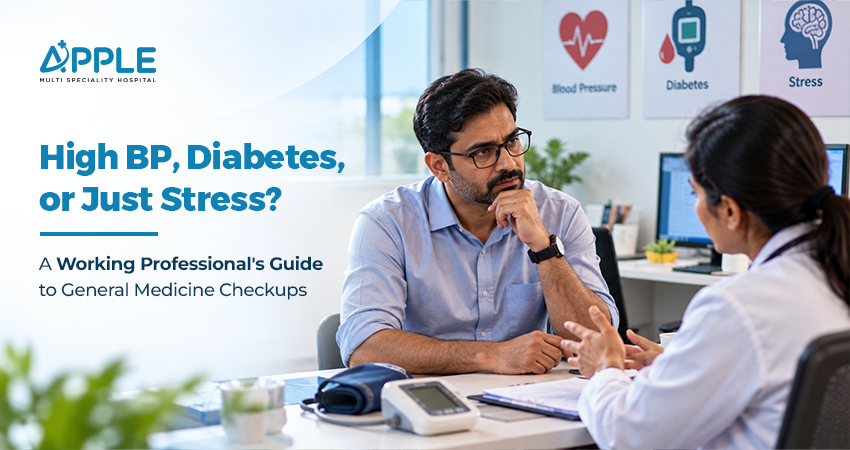
It starts with the doctor asking about you. How you’ve been feeling, for how long, what your days look like, whether these conditions run in your family. That conversation alone tells a good doctor a lot. Then the basic vitals, blood pressure measured right there, pulse, weight, a general examination. For blood pressure, that’s often enough to know whether there’s something to watch. For sugar and a few other things, the doctor may suggest a simple blood test to see clearly rather than guess. That’s it. A chat, a few measurements, and sometimes a blood test. Twenty minutes that can catch something a decade early. The reason this matters so much for BP and diabetes specifically is that both are far, far easier to manage when caught at the start, and a routine consultation is how “caught at the start” actually happens.
Here’s where the old setup quietly failed working people. If the only doctor in town was a visiting one who came once a week, getting a check-up meant lining your life up with their schedule, or travelling to Surat and losing most of a day. For someone juggling work and home, that friction was usually enough to make you skip it entirely. “I’ll go when I get time,” which means never. A full-time MD changes that equation completely. You go on the day you can, not the one day the doctor happens to be in. You go after work, on your way home, without taking leave. And because conditions like BP and diabetes need ongoing follow-up rather than a one-time visit, having the same doctor there every day is what makes that follow-up actually happen. The easier care is to reach, the more likely you are to actually get it, and your health is the thing that benefits from that gap closing.
Persistent tiredness, frequent urination especially at night, increased thirst, unexplained weight change, and slow-healing cuts are common early signs. Any one alone is often harmless, but several together over a few weeks are worth a simple blood test to be sure.
Yes, and this is exactly why it’s called a silent condition. Many people with high blood pressure feel completely fine and only find out when it’s measured. That’s the whole reason a quick BP check during a routine visit matters, it catches what you can’t feel.
Yes. Basic diagnostics including blood tests are available in-house, so a recommended sugar or other test can usually be done without a separate trip elsewhere, and your doctor discusses the results with you.
For most healthy adults, a general checkup once a year is a sensible baseline. If you already have high BP, diabetes, or a family history of them, your doctor will usually suggest checking more often so things stay well managed.
Yes. Apple Hospital runs a full-time general medicine OPD, so the MD doctor is available daily within OPD hours, not just one fixed day a week. You can go when it suits your schedule.
So, high BP, diabetes, or just stress? The honest answer is that you can’t tell from the inside, and that’s not a failing on your part, it’s simply how these conditions work. They borrow the symptoms of an ordinary tiring life, which is why so many people carry them for years without knowing. The good news is that finding out is genuinely easy. A short consultation, your blood pressure checked on the spot, a simple blood test if the doctor thinks it’s worth it. Twenty minutes against the possibility of catching something early enough to manage it comfortably for life.
And now that there’s a full-time general medicine doctor in Olpad, the last excuse, no time, too far, has mostly gone. You can go after work, close to home, on a day that suits you. If any of this has been nagging at the back of your mind, book a general medicine consultation at Apple Hospital and just find out. Knowing is almost always lighter than wondering.