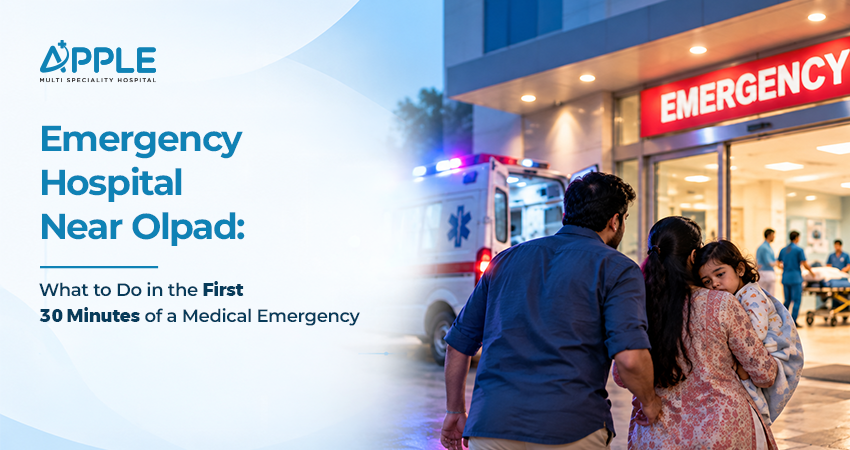
In a medical emergency, the first 30 minutes often decide the outcome. Here’s what to do, in order:
Save that for later. Now here’s why each part matters, and what changes now that Olpad has a 24×7 emergency option of its own.
An emergency is the one situation where nobody has time to think clearly, which is exactly why it helps to have thought about it beforehand. Most people in a crisis lose the first crucial minutes to panic and to the one question that used to have a terrible answer in Olpad: where do we even take them? Let’s fix that, calmly, before you ever need it.
Doctors sometimes call it the golden window, and it isn’t a figure of speech. In a heart attack, a stroke, severe bleeding, or a bad accident, the body is on a clock. Blood isn’t reaching where it needs to, or it’s leaving the body faster than it should, and every minute without the right help makes the damage harder to undo. The treatment that works brilliantly in the first half hour works less well an hour later, and sometimes not at all after that. This is the whole reason distance matters so much in an emergency. It isn’t about comfort or convenience when someone is critical. It’s that the clock is running from the moment it happens, and the time spent getting to help is time taken straight out of that golden window. A hospital fifteen minutes away and a hospital an hour away are not the same hospital when those minutes are the thing keeping someone alive.
Part of staying calm is knowing what genuinely needs the emergency room right now and what can wait for the morning’s OPD. Guessing wrong in either direction is a problem. Rush a mild fever to emergency at midnight and you’ve exhausted yourself for nothing. Wait out something serious and you lose that golden window.
Some things are emergencies, full stop, and should not be talked yourself out of. Chest pain or pressure, especially if it spreads to the arm, jaw or back, or comes with sweating and breathlessness. Real difficulty breathing. Heavy bleeding that won’t stop. A serious fall or road accident, a head injury, a deep wound, a suspected fracture. Sudden weakness or drooping on one side of the face or body, or sudden trouble speaking, which can mean a stroke. Fits or seizures. And for the little ones, a very high fever in an infant, a baby who won’t feed or wake properly, or any breathing trouble in a child. These are not wait-and-watch situations. These are get-to-emergency situations.
Here’s a simple rule that serves most situations. If the person is stable enough to travel safely, call the hospital while you set off, so the emergency team knows what’s coming and can be ready at the door. For a possible heart attack, a stroke, or an accident, calling ahead genuinely speeds up what happens the moment you arrive. If, on the other hand, someone is actively deteriorating in front of you, the priority is simply getting them to help as fast as is safe, and someone else can call on the way. Either way, you’re heading to the same place. The call just means they’re expecting you.
Knowing what to expect takes some of the fear out of it, so here’s the shape of it.
The emergency doors don’t keep office hours. There’s a team on through the night, every night, including holidays, so a 2 AM crisis is met by people who are awake and ready, not a locked gate and a phone that rings out. And the pharmacy runs 24×7 too, which matters more than people realise. In an emergency you don’t want to be sent out at midnight hunting for a chemist who’s open. The medicines needed then and there are available in the same building, at the same hour.
Treating an emergency well means knowing quickly what you’re dealing with. Is the bone broken, and how badly? Is there internal bleeding? Apple Hospital has X-ray and sonography on-site, so these answers come fast, without sending a critical patient somewhere else for a scan. Getting the picture quickly is a big part of acting quickly, and both living under one roof is exactly what an emergency needs.
Now, the honest part, because this is your health and not a sales pitch. An emergency room’s first and most vital job is to stabilise, to get a critical patient out of immediate danger. Apple Hospital is equipped to receive emergencies, stabilise patients, and provide immediate diagnostics and care. For certain highly complex trauma cases that need specialised surgical intervention, the priority is to stabilise the patient first and then move them safely onward if required, with the hospital’s team managing that handover rather than leaving a family to figure it out alone in a panic. That stabilise-first step is often the thing that saves the life, and having it fifteen minutes away instead of an hour is the entire point.
Think about what the old emergency plan actually was. Something terrible happens at home, and the clock starts. You find a vehicle, you get the person in, and then you drive, for an hour, through traffic or through the dark, with the most frightening journey of your life happening in the back seat. For the exact kind of emergency where minutes decide everything, that drive was the single biggest danger, bigger sometimes than the emergency itself. Families in and around Olpad have lived with that risk quietly for years, because there was no other option. The distance wasn’t an inconvenience. In a real crisis, the distance was the threat.
Everything above is the reason this matters so much. A town the size of Olpad, with its families, its farms, its roads and its nearby industrial belt, was always going to have emergencies. Accidents, heart attacks, difficult nights with a sick child. These were never a question of if, only when. And for too long the answer to “when” was a long drive to another city during the worst minutes of someone’s life. A 24×7 emergency option in Olpad itself closes that gap. It means the golden window is spent on treatment, not on travel. It means a family facing the scariest night of their lives has somewhere close to run to. That is not a small upgrade. For some families, it will be the difference that matters most.
Yes. The emergency department operates 24 hours a day, every day of the year, nights and holidays included. There’s a team on through the night, not a doorbell.
Yes. The pharmacy runs 24×7, so medicines needed during an emergency are available in the same building at any hour, and you’re not sent out searching for an open chemist in the middle of the night.
The emergency team receives accident and trauma cases and focuses first on stabilising the patient and running immediate diagnostics. For highly complex cases needing specialised surgery, the team stabilises first and arranges a safe onward transfer where needed, rather than leaving the family to manage it alone.
If the person is stable enough to travel, calling ahead lets the team prepare before you arrive, which saves time. If someone is deteriorating fast, just get them there safely and call on the way. Don’t delay the journey for the phone call.
Yes. With paediatric care and a NICU on-site, the hospital is set up to respond to newborn and infant emergencies, which is exactly the kind of crisis where distance used to be most frightening for young families.
Nobody wants to think about emergencies, which is precisely why the smart thing is to think about one now, calmly, when nothing is wrong. Know the warning signs that mean go immediately. Remember the first steps: stay calm, call ahead if you can, note when it started, don’t move a serious injury, and get to help as fast as is safe. And know that the destination is no longer an hour away. Olpad has its own 24×7 emergency now, with the pharmacy and the scans in the same building, so the golden window is spent where it should be.
There’s one thing you can do today that your future self may be deeply grateful for. Save Apple Hospital’s emergency number in your phone right now, and tell your family where it is. In an emergency, you won’t be in any state to go looking for it. Save it while it’s calm, so it’s there the moment it isn’t.